Welcome to the UC Berkeley Urban Bee Lab!
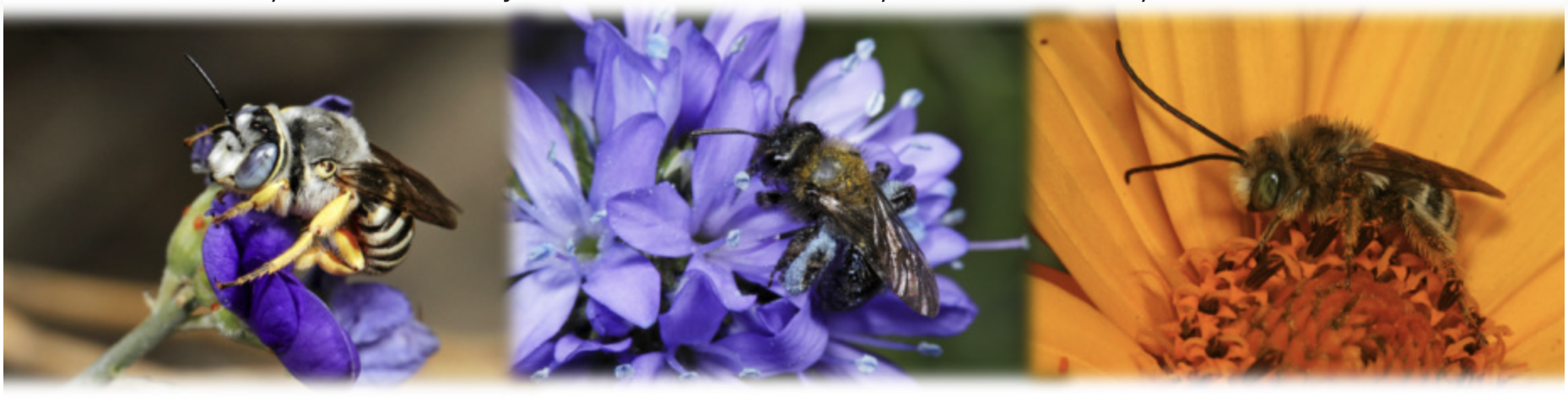
Our research group at the University of California has been documenting bee diversity and bee frequencies on wild California plants since 1987. This research led to a series of new bee sampling methods that we used to start the urban bee project in the late 1990s. After several years of sampling in residential areas of the East Bay region of the San Francisco Bay Area, we have found roughly 90 species of bees, most of which are native to California. Once data analysis is completed in other urban residential areas of the SF Bay Area, we expect this number to increase well beyond 100.
We have found that the bees have definite preferences for plants and that certain bee groups can be expected to forage for pollen and nectar on certain plants and at certain frequencies, regardless of whether the plants are native or exotic to California. We used this information to create an experimental bee garden, with the most preferred plants on the Berkeley campus of the University of California. The garden has also served as an outreach tool for advising gardeners, teachers, and other urbanites on planning their own gardens that will encourage native bees and other flower visitors.
Since our early work documenting urban bee diversity in the East Bay, we have surveyed urban gardens statewide and exported our habitat gardening model to farms in Contra Costa, Santa Barbara and Ventura Counties, studying pollinator diversity in agroecosystems.
We have found that the bees have definite preferences for plants and that certain bee groups can be expected to forage for pollen and nectar on certain plants and at certain frequencies, regardless of whether the plants are native or exotic to California. We used this information to create an experimental bee garden, with the most preferred plants on the Berkeley campus of the University of California. The garden has also served as an outreach tool for advising gardeners, teachers, and other urbanites on planning their own gardens that will encourage native bees and other flower visitors.
Since our early work documenting urban bee diversity in the East Bay, we have surveyed urban gardens statewide and exported our habitat gardening model to farms in Contra Costa, Santa Barbara and Ventura Counties, studying pollinator diversity in agroecosystems.
What is the urban bee lab?
6/26/2023
Highlighting species in Costa Rica and California, the Urban Bee Lab at the University of California, Berkeley, has amassed a collection of over 136,000 bee specimens over the span of forty years. Currently, this collection is being carefully curated by their collector, Professor emeritus Gordon W. Frankie, and a small group of undergraduate researchers. Despite no-longer lecturing as a Professor, Dr. Frankie continues his role as an educator by providing his undergraduate researchers with experience in an ever-expanding field of research, thus advancing current knowledge on bee species of the western U.S. and contributing to the vast inventory of UC Berkeley’s Essig Museum of Entomology.
The professional curation of the specimen collection is the Bee Lab’s greatest priority. According to Dr. Frankie, “This is not simply a matter of having a collection, but to develop inventory information on the bees of western U.S. and to monitor their distribution”. To assist in this goal, the specimens are labeled with their species, date of capture, and place of capture. The Lab continues to develop an extensive database, including thousands of bee species, and the plants that host them. This not only provides information on certain species and their regions of occurrence, but also their plant preferences–giving key insight into flowers and their potential to increase pollinator populations. Dr. Frankie highlights the attention to detail needed in the curation process, stating, “We cannot have mistakes, trust is important when distributing information, providing incorrect information will ruin that trust”.
The lab’s findings have been highlighted in a number of publications and two books that follow rather comprehensive approaches to the bees of California and Costa Rica, along with their respective host flowers. The lab’s first book, California Bees & Blooms: A Guide for Gardeners and Naturalists, published in 2014 by Heyday Books, describes twenty-two of the most common bee groups in California. As a description of bee behavior and plant preferences, the book displays the important roles bees play in California and includes gardening methods that can allow pollinators to flourish in urban and suburban gardens alike. The second book, Abejas de Costa Rica highlights the diversity of bees in Costa Rica, along with their symbiotic relationship with the planet; in November of this year (2023), this book will be available in an English translation.
Currently, the Urban Bee Lab is being supported by a number of small donations and grants, while continuing to contribute to various projects; the largest being UC Berkeley’s Essig Museum of Entomology—where the lab’s curated bee specimens will eventually be deposited when space is made available. Therefore, with an ever-declining pollinator population, the work done at the Urban Bee Lab is providing crucial information that will hopefully contribute to lessening the damage done to bees, not only in California and Costa Rica, but around the world.
With this, the Urban Bee Lab looks to spread its love of bees to the public and gain support in its mission to preserve a foundational segment of our ecosystems.
Credit: Josie Nadolny <j.nadolny@berkeley.edu>
The professional curation of the specimen collection is the Bee Lab’s greatest priority. According to Dr. Frankie, “This is not simply a matter of having a collection, but to develop inventory information on the bees of western U.S. and to monitor their distribution”. To assist in this goal, the specimens are labeled with their species, date of capture, and place of capture. The Lab continues to develop an extensive database, including thousands of bee species, and the plants that host them. This not only provides information on certain species and their regions of occurrence, but also their plant preferences–giving key insight into flowers and their potential to increase pollinator populations. Dr. Frankie highlights the attention to detail needed in the curation process, stating, “We cannot have mistakes, trust is important when distributing information, providing incorrect information will ruin that trust”.
The lab’s findings have been highlighted in a number of publications and two books that follow rather comprehensive approaches to the bees of California and Costa Rica, along with their respective host flowers. The lab’s first book, California Bees & Blooms: A Guide for Gardeners and Naturalists, published in 2014 by Heyday Books, describes twenty-two of the most common bee groups in California. As a description of bee behavior and plant preferences, the book displays the important roles bees play in California and includes gardening methods that can allow pollinators to flourish in urban and suburban gardens alike. The second book, Abejas de Costa Rica highlights the diversity of bees in Costa Rica, along with their symbiotic relationship with the planet; in November of this year (2023), this book will be available in an English translation.
Currently, the Urban Bee Lab is being supported by a number of small donations and grants, while continuing to contribute to various projects; the largest being UC Berkeley’s Essig Museum of Entomology—where the lab’s curated bee specimens will eventually be deposited when space is made available. Therefore, with an ever-declining pollinator population, the work done at the Urban Bee Lab is providing crucial information that will hopefully contribute to lessening the damage done to bees, not only in California and Costa Rica, but around the world.
With this, the Urban Bee Lab looks to spread its love of bees to the public and gain support in its mission to preserve a foundational segment of our ecosystems.
Credit: Josie Nadolny <j.nadolny@berkeley.edu>
